
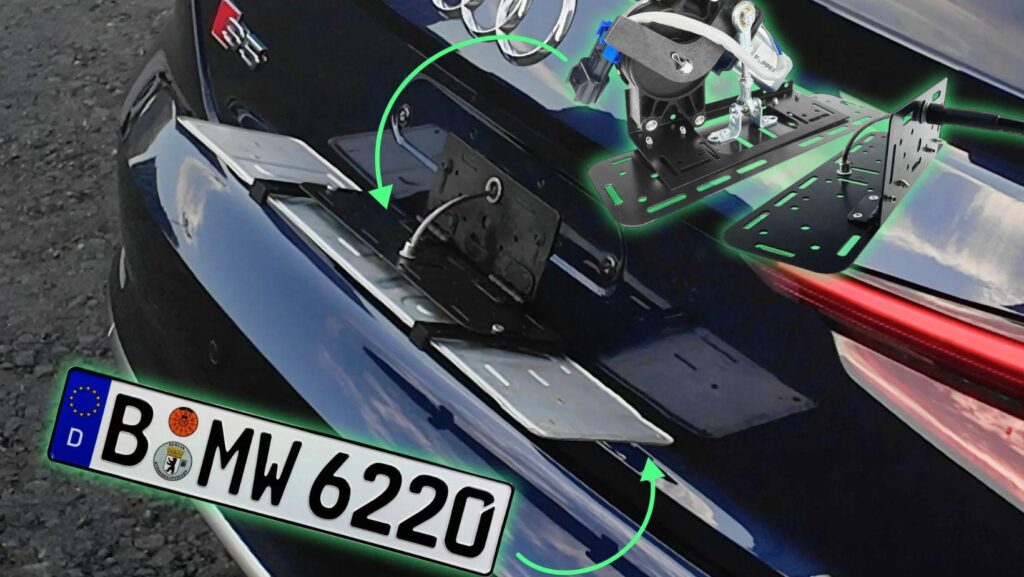
Automotive accessories often look simple from the outside, but their design can involve careful mechanical and electrical engineering. A folding license plate system is a good example. It must support the plate securely while allowing controlled movement within a compact space.
A folding license plate holder from Alite combines a movable frame with an electric drive and remote control. Unlike a fixed holder, the system allows the plate to change position while remaining attached to the same assembly. This requires the frame, moving joints, motor, and electronic components to work together.
Engineering a Moving Plate Frame
The frame forms the structural foundation of the system. It has to hold the license plate while supporting repeated movement between its designed positions. This creates different engineering requirements from those of a conventional static holder.
The moving parts need enough clearance to operate without unnecessary friction or obstruction. At the same time, excessive movement between components could reduce stability.
Several elements influence the mechanical design:
- frame dimensions and plate compatibility;
- position of moving joints;
- range of movement;
- electric drive placement;
- mounting points and available space.
These elements are interconnected. Changing the position of one component can affect the movement of another, so the entire assembly needs to be considered as one mechanism.
How the Electric Drive Creates Movement
Remote-controlled folding systems use an electric drive to convert electrical energy into mechanical movement. When the control system receives a command, the drive moves the section of the frame holding the license plate.
The process can be divided into four stages:
- A command is sent through the remote control.
- The controller receives the signal.
- Power activates the electric drive.
- The mechanism moves the plate to its designed position.
The plate itself does not need to be detached during this process. It remains mounted to the folding section while the mechanism controls its position.
Compact packaging is important because the space around a license plate is limited. The motor, wiring, frame, and moving elements need to fit without making the complete assembly unnecessarily large.
Why Geometry and Compatibility Matter
License plate dimensions are not universal. Countries and vehicle categories can use different widths, heights, proportions, and mounting arrangements. These differences directly affect the engineering of a folding holder.
A mechanism designed around one plate format may not provide the same fit for another. The frame must also have enough room to complete its intended movement without contacting nearby vehicle components.
Alite develops folding frames for supported plate formats, allowing the dimensions of the holder and its moving structure to correspond to the intended application.
Installation is another part of the engineering equation. Correct positioning helps the mechanism move through its designed range, while appropriate electrical connections provide power to the drive and controller.
Combining Mechanics With Remote Control
A folding holder is not purely mechanical. Remote operation adds an electronic layer to the system and removes the need to adjust the frame manually each time.
The controller acts as the link between the user’s command and the moving mechanism. Once a signal is received, the electrical and mechanical components work together to perform the movement.
This combination reflects a wider direction in automotive accessory design. Compact electronics and electric drives allow relatively small components to perform controlled mechanical actions.
Engineering in a Compact Automotive Accessory
The engineering behind a folding license plate holder depends on more than simply adding a hinge to a conventional frame. Geometry, mounting, electric drive placement, plate dimensions, wiring, and remote control all influence how the finished system operates.
Alite folding frames bring these elements together in a compact assembly designed around supported license plate formats. The result demonstrates how mechanical movement and electronic control can be integrated into a small automotive accessory.