
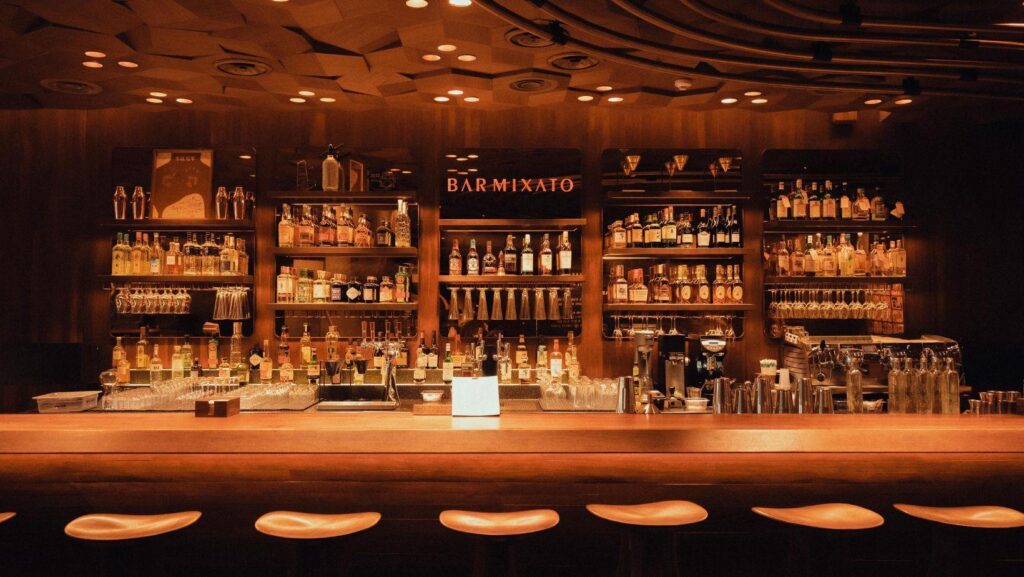
Anticipate what a bar counter contains five years from now. Power at every position. Wireless charging pads set into the surface. Order terminals or tap points at intervals. Lighting integrated into the counter edge, controlled from somewhere else. Sensors that know which positions are occupied.
Almost none of that exists in most bars today and the direction is clear enough to plan for. What it means for commercial grade bar stools is that the stool stops being a standalone object and becomes a component in a serviced counter, and several things that were free choices become constraints.
The Counter Becomes Infrastructure
Start with the shift, because everything else follows from it.
A traditional bar counter is a surface on a structure. A wired counter is a surface on a structure containing cable routes, power distribution, data, and equipment that will need replacing on a shorter cycle than the joinery.
Once that is true, the counter has service requirements. Access panels, cable slack, a route for someone to reach a failed module without dismantling the bar face. Those requirements interact directly with what sits in front of the counter, because a stool run determines whether anybody can physically reach the underside.
Charging Puts a Dimension Constraint on the Top
The first specific consequence is about the surface and it is a real limitation.
Wireless charging built into a counter, working to the USB and Qi ecosystem most guests now carry, transmits through the top material up to a limited thickness. That constrains the counter build, which in turn constrains the height, which in turn constrains the stool.
A counter that gained an inch of thickness to house charging hardware has moved the seat-to-surface clearance. Ten to twelve inches is what a body needs, and a stool ordered against the drawing rather than against the built counter will be an inch out across the whole run.
Anything Transmitting Needs Authorization
The second consequence is regulatory and it separates properly specified components from generic ones.
Equipment that emits radio frequency energy requires authorization before it can be sold in the United States, and the Federal Communications Commission publishes the framework it falls under.
That matters when specifying a counter with embedded charging, because the market contains a great many uncertified modules sold on price. A bar installing them has put unauthorized transmitters into a public space, in a fixture nobody will inspect again for a decade.
The Stool Has to Allow Service Access
The third consequence is the one nobody plans for and everybody eventually needs.
A module fails. Somebody has to reach the underside of the counter, in a live room, without taking the bar out of service for a day. If the stool run is fixed to the floor, or if the stools are heavy enough that moving eight of them is a two-person job, that repair becomes an event.
Stools that are light, that stack, and that are not floor-fixed turn a service call into a twenty-minute job. It is an unglamorous specification and it is the difference between a counter that gets maintained and one that quietly accumulates dead positions.
Dead positions are worse than they sound. A charging pad that stopped working is not reported by guests, it is simply avoided, and the bar loses a seat without anybody logging a fault.
Occupancy Sensing Changes the Layout Question
The fourth consequence is about data and it is the part most likely to arrive sooner than expected.
A counter that knows which positions are occupied produces exactly the information the seating argument has always lacked. Which seats fill first, which stay empty, how long people stay in each, and how all of that varies by hour.
Rooms with that data will discover things they currently guess about, and some of it will be uncomfortable. That the two positions nearest the service well are never chosen. That the backed stools hold people ninety minutes longer. That the accessible position is used more than anybody assumed, or not at all because of where it sits.
Egress Does Not Change, and Gets Forgotten
The fifth consequence is that none of this relaxes anything.
Occupant load and egress requirements under the Life Safety Code depend on how a space is used and how it is furnished. Adding four positions because the counter now supports them is a change to the configuration.
Wired counters tend to encourage more seats, because each position now has a reason to exist. That is exactly the pressure that pushes a room past its calculated occupancy without anybody deciding to.
What to Specify for a Counter That Will Be Wired
For an operator building or refitting a bar with this in mind:
- Run conduit and cable routes now, even if nothing is installed yet
- Confirm the built counter height before ordering stools, not the drawn height
- Certified charging modules only, with the authorization documented
- Access panels under the counter, positioned where a stool can be moved aside
- Stools light enough for one person to clear eight positions quickly
- No floor-fixed stools on any section containing serviceable equipment
- Occupant load recalculated whenever positions are added
The Counter Stops Being Carpentry
Imagine the bar refit five years from now. The counter arrives as a serviced assembly rather than as joinery. The stool specification includes a maximum weight, because somebody has to move them for maintenance, and the seat height is confirmed against a built dimension rather than a drawn one.
None of that requires anything that does not already exist. What it requires is treating the counter and the seating as one system with a service life and a maintenance plan, rather than as a piece of carpentry with furniture in front of it.
The bars that plan for it now will be running wired counters cheaply. The ones that do not will be quoting for a bar face to be dismantled, because the only way to reach a failed charging pad is through the front.