
Key Takeaway
For teams managing multilingual content across multiple channels, a headless CMS typically reduces operational complexity by separating content from presentation, enabling structured translation workflows and locale-aware API delivery that traditional CMS architectures cannot match without significant customization.
TL;DR – A headless CMS generally offers superior multilingual capabilities because it stores content as structured, API-accessible data rather than embedding it in templates. This separation makes it dramatically easier to translate content field by field, deliver localized versions across web pages, mobile apps, and other platforms simultaneously, and add new locales without modifying frontend code. Traditional CMS platforms remain viable for single-language sites or teams without frontend development resources, but they struggle at scale when managing content in multiple languages across different regions.
Introduction
In 2026, operating a multilingual website is no longer a competitive advantage reserved for enterprise brands. It is baseline infrastructure for any organization pursuing global customers. For teams evaluating CMS platforms, the architecture chosen today determines how efficiently they can publish content tomorrow – in five languages or fifty.
The choice between a headless content management system and a traditional CMS is not a matter of trend-chasing. It is a structural decision that shapes translation workflows, content delivery across multiple devices, team collaboration models, and long-term scalability. Not all CMS platforms support complex multilingual content, and the wrong foundation creates compounding friction as your organization enters new markets. For a detailed breakdown of why modern teams are choosing headless for global content, Crowdin’s guide on web cms localization explains how structured, API-accessible fields make automated translation workflows possible.
This article provides a technical comparison of headless and traditional CMS architectures specifically through the lens of multilingual operations. It covers how each approach handles content localization, translation process integration, multichannel delivery, and team scaling. It also addresses when traditional CMS remains the right choice, and what migration looks like for teams making the switch.
What Is a Traditional CMS (and Why It Was the Default for Decades)
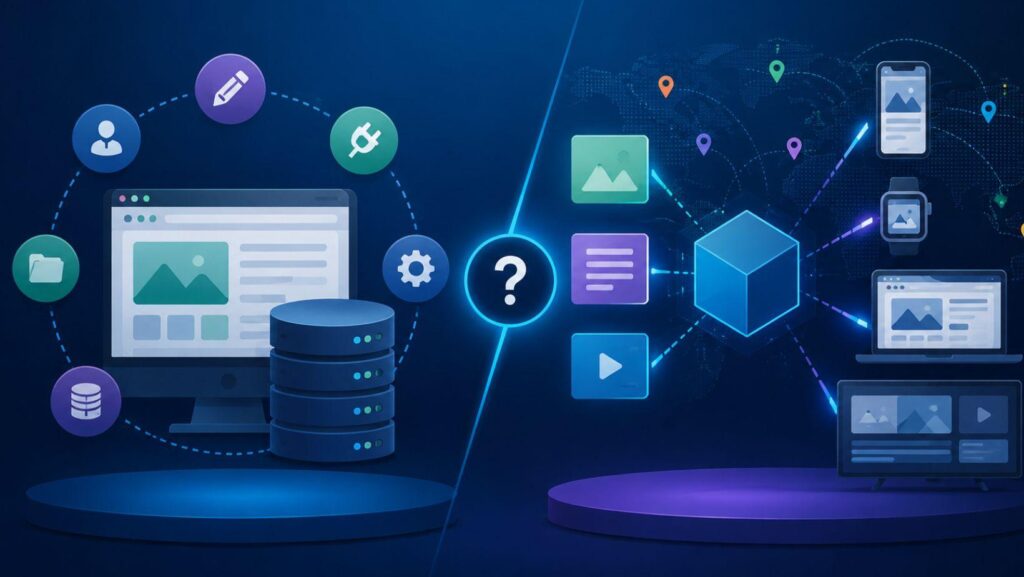
A traditional CMS – sometimes called a monolithic or coupled content management system CMS – integrates backend content storage with frontend presentation in a single platform. A traditional CMS couples the content management backend with the frontend, meaning editors write content directly within templates that also define layout, styling, and rendering logic. WordPress, Drupal, and Joomla in their classic configurations are the defining examples of this architecture.
This model made sense for two decades. In the early web era, digital presence typically meant one website in one dominant language. Traditional CMSs have a monolithic architecture tightly coupling back-end and front-end, which was efficient when teams needed to manage content on a single site with minimal complexity. Non technical users could select themes, install a translation plugin, and publish content without developer involvement. Traditional CMS is often simpler to set up and use for standard websites, which explains why WordPress alone powers roughly 64% of websites using a content management system. The ecosystem of plugins, themes, and community knowledge created low barriers to entry that headless architectures still cannot fully replicate for smaller teams.
What Is a Headless CMS (and Why It Changed the Conversation)
A headless CMS separates content management from content display using APIs. The backend handles content creation, versioning, and asset management. The presentation layer is entirely independent – built with whatever front end framework the development team prefers. A headless CMS delivers content via APIs to any device, whether that is a React-powered website, a native mobile app, a kiosk display, or a voice interface.
Platforms like Contentful, Strapi, Sanity, Storyblok, and Contentstack represent this architecture. Content exists as structured data – defined by content models with explicit fields, metadata, and relationships – accessible via REST or GraphQL endpoints. A headless CMS separates content creation from presentation, and this decoupling is the architectural foundation for every multilingual advantage discussed below. Headless CMS supports multiple programming languages for content delivery, meaning development teams are not locked into a specific technology stack. When the same content needs to reach different platforms in different languages, this flexibility becomes decisive.
Architectural Differences That Matter for Multilingual Sites
The practical implications of these architectures diverge sharply once multilingual content enters the equation. Five dimensions matter most when evaluating cms platforms for international operations.
Content-Presentation Coupling
In traditional CMS platforms, content and HTML markup are intertwined within templates. Translators working with template-embedded strings must navigate around layout code, increasing the risk of breaking markup during the localization process. A headless CMS stores content in discrete, structured fields – plain text, rich text, metadata – with no embedded presentation logic. This means translators work on clean content units, and the translation process operates on data rather than page templates. Traditional CMSs typically require a specific programming language for content delivery, further constraining how localized content reaches the user.
Localization Surface Area
Traditional CMS requires localization of both content and presentation code. Menu labels, widget text, date formats, and component strings often live inside theme files, requiring developer involvement for every locale. With a headless CMS, the localization surface area narrows to content fields. UI strings and navigation labels can be stored in locale files or content models with defined fallback rules, reducing the total surface that needs managing localization attention. 24% of companies describe CMS integrations as difficult, and this complexity multiplies when template-level localization is layered on top of content translation.
Multichannel Delivery
Traditional CMSs struggle with delivering content across multiple channels. If the same content needs to appear in a mobile app, a progressive web app, and a desktop site – each potentially serving different regions – traditional architectures require content duplication or custom solutions. Headless CMS architecture supports content delivery to websites and mobile apps from a single content source. Omnichannel publishing allows distribution to multiple devices without content duplication, and content can be updated across all channels instantly with a headless CMS. For multilingual operations, this means one content entry with locale variants feeds every channel.
Translation Workflow Integration
Structured, field-level content is dramatically easier to route through a translation management system than template-embedded strings. Headless CMS allows efficient multilingual content management across platforms because individual fields can be extracted programmatically, sent to translation tools, and returned to locale-specific fields via API integration. Traditional CMS translation workflows often rely on plugins that export content in bulk, but 40% of marketers find collaboration with developers ineffective – a friction point that intensifies when translation workflows require template-level coordination. A good CMS should integrate with translation management systems, and headless architectures make that smooth integration structurally simpler.
Why Headless Simplifies Translation and Localization
Beyond architectural differences, the day-to-day mechanics of managing multilingual content diverge significantly between the two approaches.
Field-level content extraction eliminates the need for HTML scraping. In a headless CMS, only localizable fields are included in translation exports – no embedded markup, no manual file handling to clean layout code from translatable text. This reduces error rates and accelerates the translation process for professional translators working in the target language.
Locale-aware API responses handle language routing at the infrastructure level. Frontends specify a locale parameter; the CMS returns the appropriate content variant or applies fallback rules. Accept-Language headers or geographic detection can route users to their preferred language without maintaining separate site copies – a pattern that scales to support multiple languages without multiplying infrastructure.
Translation memory integration becomes practical when content is structured and accessible via direct API connections. Translation memory systems reference previous translations to avoid redundant work, and headless CMS platforms expose content at the granularity needed to make this effective. Continuous localization workflows use webhook automation to trigger translation jobs when source content is published or updated. When translation is complete, callbacks return content to locale-specific fields automatically, reducing delays and eliminating manual round-trips between content editors and translators.
Human review processes operate more effectively on structured content. Even when machine translation provides initial drafts, human post-editing requires clear field boundaries and approval workflows per locale. Some headless platforms support multi-step workflows: automated translation, then human review, then subject-matter expert approval – each operating on well-defined content units rather than full page templates.
Scalability Benefits for Global Content Operations
The operational advantages of headless architecture compound as the number of supported locales grows.
● Adding locales without codebase modifications. New locales can be enabled in content settings and translation fields activated without touching frontend logic – provided the frontend architecture anticipates locale variants. In traditional CMS, adding a new language often means replicating site structures or building custom templates per locale.
● Content-as-a-service model. Once digital content is stored as structured, locale-aware data, the same content entry serves web pages, mobile apps, and any future platform. For multilingual operations, this eliminates content duplication across channels and reduces inconsistencies that erode brand trust with global customers.
● Performance at the edge. Headless frontends leverage static builds, server side rendering, and CDN caching per locale. One case study illustrates the impact: a tour operator replaced an English-only WordPress site with a headless architecture using Next.js, localized in 8 languages. Mobile Lighthouse scores reached approximately 96, Largest Contentful Paint dropped from roughly 4.2 seconds to 1.6 seconds on mobile, and organic traffic grew 3.4 times in 12 months. Non-English bookings increased by 85%.
● Cost economics at scale. Beyond five to ten locales, traditional CMS approaches face compounding overhead from content duplication, manual coordination, and translation memory underuse. Oetiker migrated from a legacy CMS to a headless CMS in six months, achieving support for 10 or more languages across 31 locales with shorter lead times for content rollout.
● Team scaling. Content editors, translators, and developers work on independent tracks. Developers build frontends and content structure. Editors shape content in the source language. Translators operate in their translation management system or integrated platform. Reviewers manage target locale variants. All can work concurrently. Headless CMS enables faster campaign launches without developer delays, and headless CMS provides greater flexibility for content management workflows – advantages that traditional CMS platforms cannot easily replicate when diverse content must reach multiple markets.
When Traditional CMS Is Still the Right Choice
Headless architecture is not universally superior. Several scenarios favor traditional CMS platforms, and an honest content strategy evaluation should account for them.
Single-language sites with no international expansion plans gain little from the overhead of schema design, API-based delivery, and locale infrastructure. The complexity is not justified when the target market speaks one language.
Marketing-heavy websites with complex visual layout requirements often need rapid drag-and-drop editing, live preview, and user friendly interface capabilities that traditional CMS platforms provide out of the box. Headless systems typically require custom tooling to achieve similar visual editing, demanding developer time that smaller teams may not have.
Teams without frontend development capacity face a real barrier. Headless CMS demands maintaining separate frontend codebases, managing locale routing, and handling SEO concerns in code. If staff are limited or budget constrained, a traditional CMS with a translation plugin and established theme may deliver more value per dollar.
Legacy content ecosystems – large volumes of content with template-embedded text, established URL structures, and plugin dependencies – carry substantial migration risk. SEO continuity, redirect strategy, and internal linking must be carefully managed. When migration risk exceeds the operational benefit of headless, staying with a non headless CMS is the pragmatic choice.
Smaller websites with few static web pages, limited multilingual content needs, and low traffic volumes rarely justify the infrastructure overhead of a headless architecture.
Migration Considerations for Teams Making the Switch
For teams that have decided headless is the right fit, the transition requires deliberate planning.
Content model design comes first. Before selecting a platform, define entities, fields, which fields are localizable versus shared, locale codes, fallback policies, and SEO metadata including slugs and hreflang signals. CMS platforms should provide language-specific URLs and tags, and the content model must accommodate this from day one. Schema design mistakes lead to costly rework that delays the entire localization strategy.
Migration strategy: big-bang vs incremental. Big-bang migration – moving the entire site at once – offers faster cutover but carries higher risk of SEO disruption, broken links, and content gaps. Incremental migration moves sections progressively (marketing pages first, then blog, then product catalog), allowing teams to test localization workflows and refine editorial processes. Most teams with moderate content volumes (100 to 500 pages, 3 to 5 locales) find incremental migrations take 3 to 6 months. Large enterprise sites with complex templates and many locales can span 9 to 18 months.
Translation memory portability. If the existing traditional CMS uses a TMS or translation plugin, export translation memory in standard formats (TMX or equivalent) so previous translations carry forward. Glossaries and style guides should transfer as well – losing institutional translation knowledge increases cost and inconsistency.
Frequently Asked Questions
What is the main difference between headless and traditional CMS?
A headless CMS separates the content management backend from the presentation layer, delivering content via APIs to any frontend. A traditional CMS couples both layers, rendering content within its own templating system. This architectural difference determines how teams manage content, deliver localized versions, and scale across multiple platforms.
Is headless CMS always better for multilingual websites?
Not always. For single-language sites, small teams without developer resources, or organizations with heavy visual editing requirements, traditional CMS platforms remain practical. Headless excels when the content strategy involves multiple languages, multiple channels, and the need to translate content at scale with streamlined workflows.
How does headless CMS handle SEO for multilingual sites?
The frontend application handles locale-specific metadata, hreflang implementation, localized slugs, and sitemap generation per locale. Headless CMS enhances security by isolating the content management backend, but SEO responsibilities shift to the development team. Frameworks like Next.js provide tooling for this, though it requires more deliberate implementation than plugin-based solutions in traditional CMS. Search engines require consistent hreflang signals and canonical URLs per locale.
Conclusion
The question is not which architecture is universally better. It is which architecture fits your team’s specific operational reality. For organizations that need to deliver content in multiple languages, across multiple brands and channels, with complete control over translation workflows and the ability to enter new markets without re-architecting their frontend – headless CMS provides a structural advantage that compounds over time. Headless CMS allows content delivery across multiple platforms seamlessly, and this capability becomes increasingly valuable as multilingual support moves from optional feature to strategic requirement.
Traditional CMS platforms earn their place for teams operating in a single language, managing limited content localization needs, or lacking the development resources to maintain decoupled frontends. Their user friendly interface, established plugin ecosystems, and lower initial complexity remain genuine advantages for the right use case.
The right content management system is the one that matches where your organization is heading – not just where it is today. Start with the content model. Define your localization strategy. Then choose the architecture that supports it.
For teams building modern content architectures, the MACH Alliance publishes vendor-neutral frameworks and case studies on composable, API-first content architectures that increasingly guide enterprise decisions in 2026 – a useful reference point for teams designing multilingual content operations at scale.